Factorial
Estimate main effects and interactions with transparent two-level designs.
Plan defensible experiments, reveal interactions, model response surfaces, optimize factor settings, and document confirmation evidence in one guided laboratory.
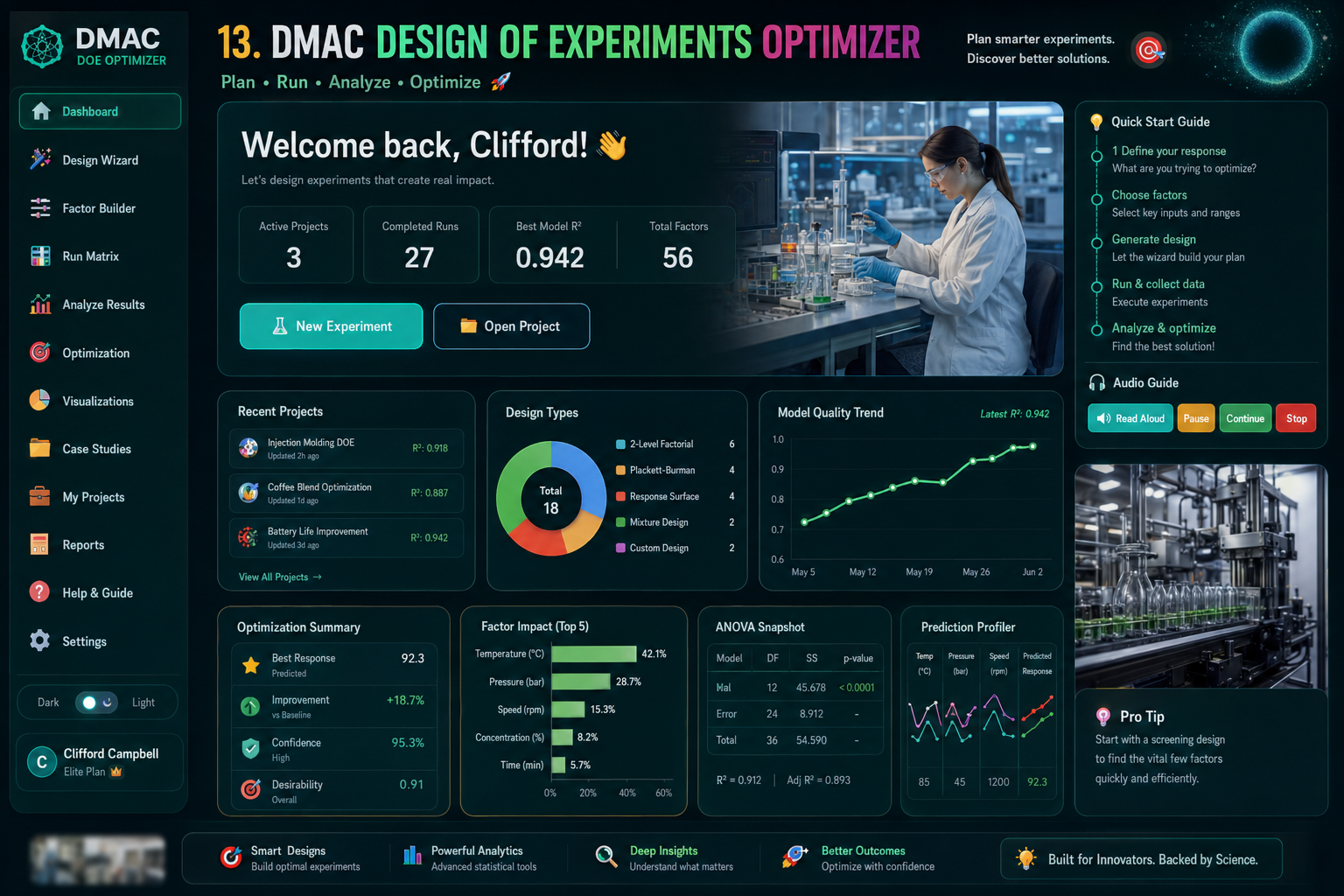
The guided recommender balances factor count, curvature, precision, run capacity, and budget.
Estimate main effects and interactions with transparent two-level designs.
Reduce runs while preserving screening power and documenting alias risk.
Narrow large factor sets before investing in detailed optimization.
Model curvature with central composite and Box-Behnken designs.
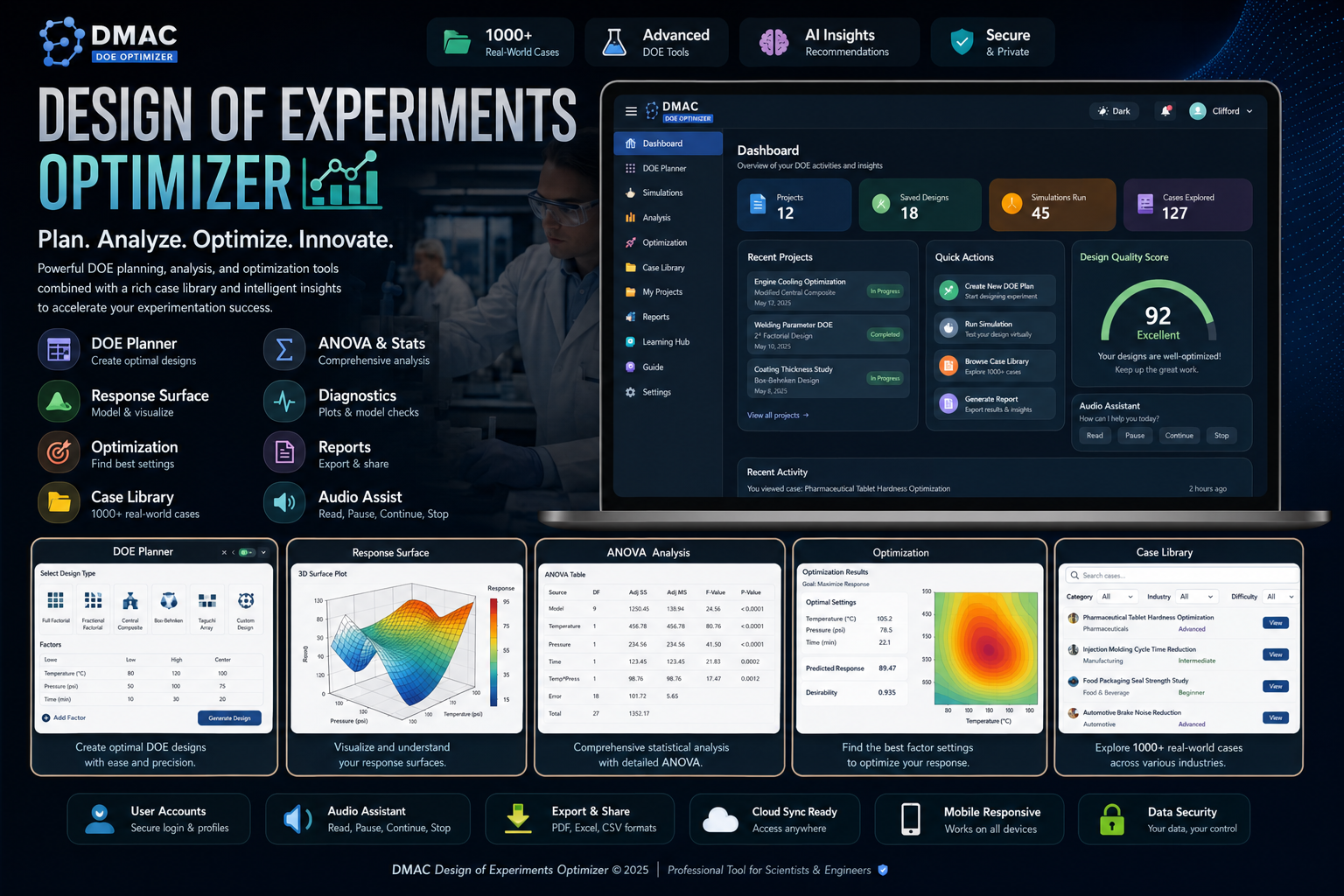
Explore manufacturing, healthcare, logistics, finance, software, public service, construction, education, and more. Filter by industry, difficulty, and design type. View any case without changing it, or save it as your own editable experiment.
Plain-language prompts explain what to do next and why.
Regression, ANOVA, residuals, effects, and response surfaces.
Translate fitted models into candidate settings and confirmation plans.
Risk registers, assumptions, audit history, and clear limitations.
This application is an educational and decision-support tool. It does not replace qualified statistical, engineering, scientific, medical, legal, regulatory, safety, or quality judgment. Users must verify assumptions, measurement systems, experimental safety, applicable standards, and confirmation evidence before implementation.